Wholesale vs Dropshipping Watches: Which Model Gives Better Margins?
November 10, 2026 · Updated November 18, 2026
When comparing wholesale vs dropshipping watches, the most profitable option is not necessarily the one with the highest advertised markup. Retailers need to consider product costs, fulfilment, marketing, returns, inventory investment and cash flow before deciding which model makes better commercial sense.
Wholesale can offer a higher contribution per watch because retailers purchase inventory in larger quantities. However, it requires capital upfront and creates the possibility of unsold stock. Dropshipping watches can reduce the initial investment, but higher per-order supplier and fulfilment costs may leave less money from each sale.
Understanding the actual dropshipping watches profit margin is therefore important. The right decision depends on sales volume, supplier pricing, customer demand and how much financial risk the retailer can reasonably accept.
1. Understand the Cost Structure of Each Model
Before comparing margins, retailers should understand where their money goes under each arrangement.
Wholesale costs
A wholesale retailer purchases watches before selling them to customers. The initial investment covers the inventory, but the real cost of holding stock extends beyond the supplier's invoice.
Common expenses include:
- Product purchase price and inbound freight.
- Customs duties, import taxes and clearance fees where applicable.
- Warehouse storage and inventory insurance.
- Packaging, picking and dispatch.
- Payment processing and marketing.
- Returns, warranty handling and potential stock obsolescence.
The advantage is that purchasing in larger quantities can improve unit economics. Retailers may also have greater control over stock availability, packaging and dispatch.
Dropshipping costs
A dropshipping retailer lists products online and purchases them from a supplier when an order is received. The supplier holds the stock and fulfils the customer's order.
Typical costs include:
- Supplier dropshipping price.
- Direct-to-customer shipping.
- Payment processing fees.
- Advertising and customer acquisition.
- Ecommerce platform and integration subscriptions.
- Returns, refunds and customer service.
Dropshipping removes the need to purchase large quantities of inventory in advance. However, the convenience of supplier-managed fulfilment may come with a higher per-unit purchase price.
For retailers comparing these arrangements, Watches of Dubai's wholesale and dropshipping services provide a starting point for reviewing the available supply options.
2. Wholesale vs Dropshipping Watches: A $200 Cost Comparison
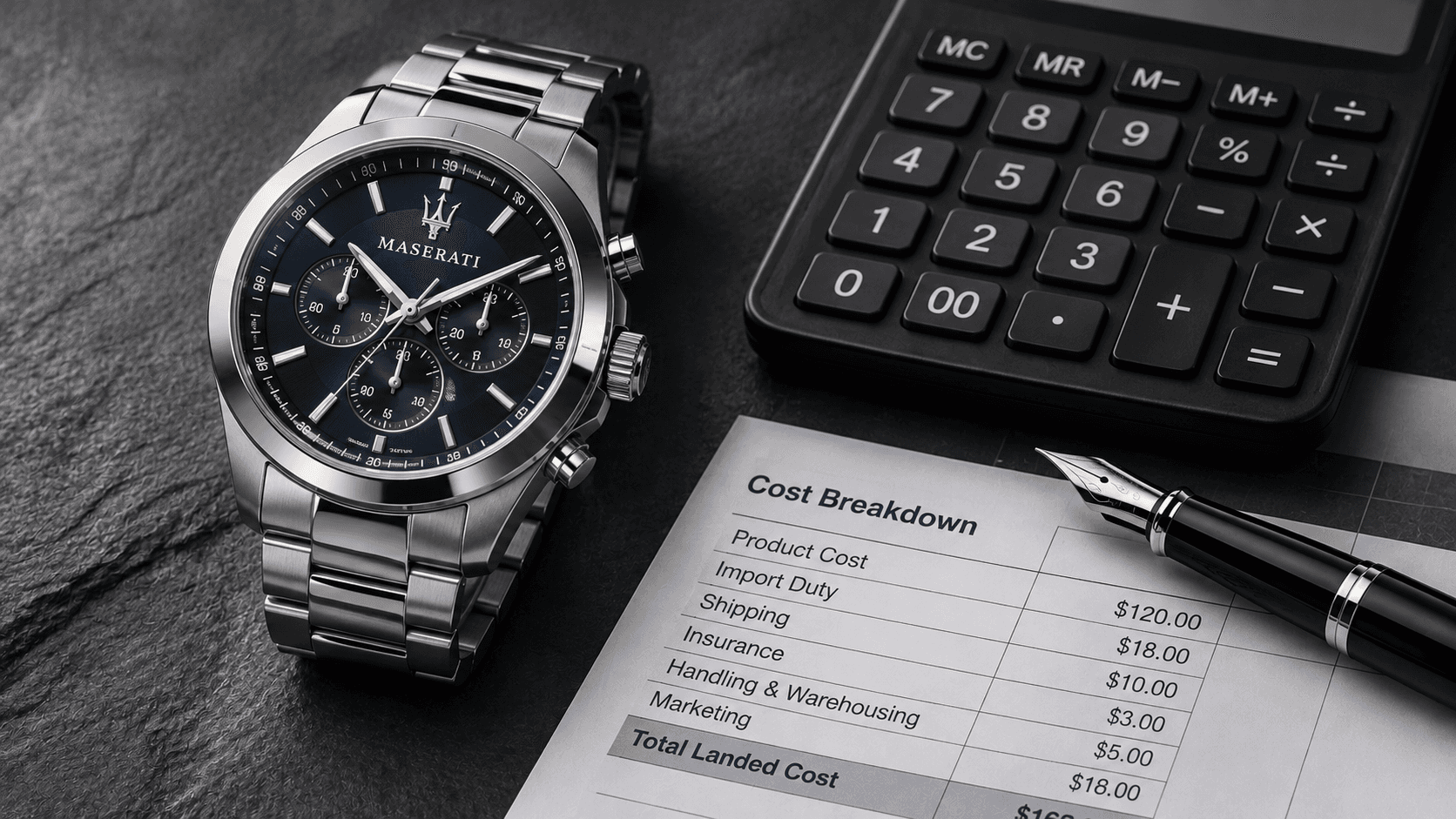
Consider a retailer selling the same watch for $200 under both models.
The following example uses hypothetical figures to demonstrate how the costs affect the final contribution.
Cost per order | Wholesale | Dropshipping |
|---|---|---|
Selling price | $200 | $200 |
Product cost | $90 | $108 |
Fulfilment and shipping | $12 | $18 |
Payment processing | $6 | $6 |
Marketing | $35 | $35 |
Expected returns allowance | $7 | $7 |
Storage / integration allocation | $10 | $3 |
Total costs | $160 | $177 |
Contribution per order | $40 | $23 |
Contribution margin | 20% | 11.5% |
All figures are hypothetical assumptions, not Watches of Dubai quotations or industry averages.
In this example, wholesale generates $40 per order, compared with $23 for dropshipping. The difference is $17 per watch.
The calculation is:
Contribution = Selling price − Variable and allocated operating costs
Contribution margin = Contribution ÷ Selling price × 100
The $40 and $23 figures represent contribution before general fixed overhead, income tax and owner compensation. They should not be confused with net profit.
For payment processing, the assumed $6 is illustrative. Actual fees depend on the payment provider, country, card type and transaction currency. For example, Stripe's published pricing lists a US domestic online card rate of 2.9% plus $0.30 per successful transaction. Retailers should substitute their own applicable rates.
3. Is Dropshipping Watches Profitable After All Costs?
The answer is yes, provided the retailer can maintain sufficient contribution after supplier charges, customer acquisition and fulfilment expenses.
The absence of inventory investment does not mean that dropshipping is automatically profitable. A retailer can generate substantial sales revenue while retaining very little after paying for advertising, supplier fulfilment and returns.
Consider the hypothetical $200 watch above. The dropshipping contribution is $23 per completed order.
If the retailer receives 30 orders in a month:
- Sales revenue: $6,000.
- Contribution: $690.
- Contribution margin: 11.5%.
However, the result changes if sales slow down or return expenses increase.
Worked downside scenario: Low sales and higher returns
Assume the retailer initially expects 30 orders per month but receives only 10.
Under the wholesale arrangement, purchasing 30 watches at $90 each requires $2,700 upfront. If only 10 watches sell, $1,800 of the original purchase cost remains tied up in the 20 unsold watches.
The 10 sales generate $400 in contribution using the original $40-per-order assumption, but the retailer still has inventory to finance, store and eventually sell.
Under dropshipping, 10 orders generate $230 in contribution using the original $23-per-order assumption. There is no equivalent 20-unit inventory commitment.
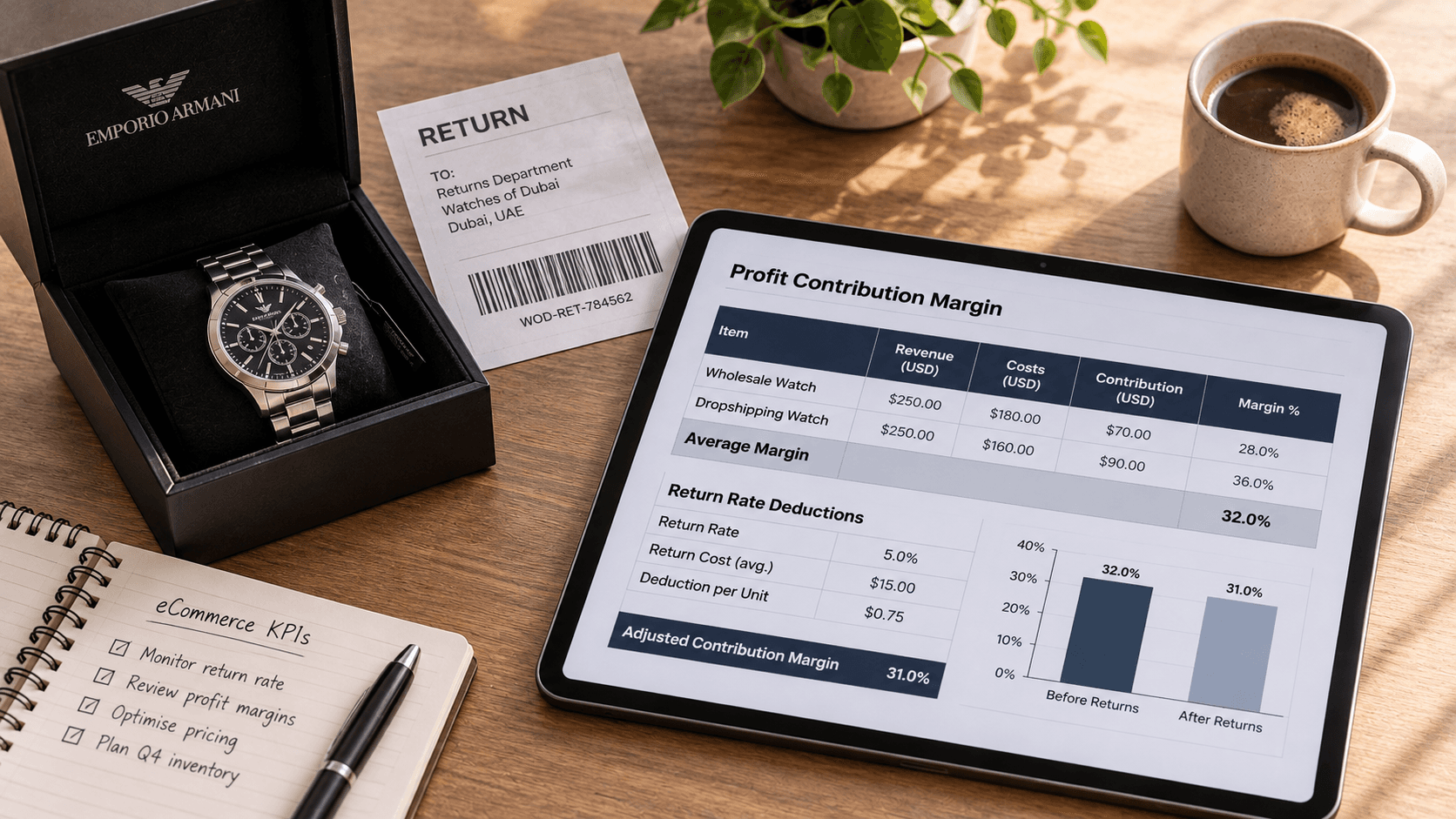
Now consider a higher-return environment. Suppose the retailer's expected returns allowance rises from $7 to $20 per order because reverse shipping, inspection, refund administration and other return-related costs are higher.
Calculation | Wholesale | Dropshipping |
|---|---|---|
Original contribution | $40 | $23 |
Additional return allowance | $13 | $13 |
Revised contribution | $27 | $10 |
Revised contribution margin | 13.5% | 5% |
Contribution on 10 orders | $270 | $100 |
This is a simplified stress test, not a claim that every 20% return rate produces a $20 loss per order. The $20 allowance is an assumed average cost that retailers must replace with their own return data.
The lesson is that a higher wholesale contribution does not eliminate inventory risk, while a lower dropshipping contribution can become difficult to sustain when returns and acquisition costs rise.
4. Watch-Specific Costs That Can Change the Margin
Watches have particular fulfilment and handling requirements that retailers should include in their calculations.
Shipping and packaging
Watches are relatively compact, but their packaging can include presentation boxes, protective materials, warranty documentation and additional accessories.
A damaged presentation box or poorly protected watch can lead to customer complaints even when the watch itself remains functional.
Retailers should compare the complete shipping cost, including packaging, picking, handling, tracking and any additional charges for international delivery.
For wholesale orders, inbound freight may be spread across several units. For dropshipping orders, individual parcels may attract a higher shipping cost per watch.
Customs duties and import taxes
International watch shipments can incur import duties, VAT or GST, customs clearance fees and other destination-specific charges.
The applicable amount depends on factors such as the watch's tariff classification, materials, movement, country of origin, declared value and destination.
Retailers should establish whether the supplier ships under a Delivered Duty Paid (DDP) arrangement or whether the customer or retailer is responsible for import charges.
The UK Government Trade Tariff provides an example of how importers can identify commodity codes and applicable duty and VAT rates. For international shipments, DHL's customs guidance explains the importance of accurate product descriptions, values and customs declarations.
Shipping insurance
The loss of a low-cost parcel may be manageable, but a missing or damaged higher-value watch can create a substantial financial problem.
Retailers should check the carrier's standard liability, optional shipment protection, exclusions, claim requirements and maximum covered value.
Do not assume that standard shipping liability automatically covers the full retail value of a luxury watch.
DHL's shipment value protection guidance provides an example of the considerations involved in protecting higher-value shipments.
Returns, warranty and inspection
Returns are particularly important when selling branded watches because customers may raise concerns about condition, accuracy, packaging, accessories or warranty documentation.
Wholesale retailers may have more control over inspecting returned watches and preparing them for resale. However, they also need to manage the physical return process and any resulting stock depreciation.
Dropshipping retailers may rely on their supplier to inspect and process returned products. The retailer must still understand who pays for return shipping, replacement orders, refunds and warranty-related handling.
The National Retail Federation's 2025 Retail Returns Landscape estimated that 19.3% of online sales across the retail industry would be returned in 2025. This is an overall retail estimate, not a watch-specific return rate, but it demonstrates why returns should be included in ecommerce financial planning.
5. Understand the Cash Conversion Cycle
Profitability and cash flow are related, but they are not the same.
Wholesale can produce a higher contribution per watch while requiring the retailer to wait longer before recovering the money invested in inventory.
The cash conversion cycle helps measure how long cash remains tied up in business operations.
A simplified formula is:
Cash Conversion Cycle = Inventory Days + Receivable Days − Payable Days
Consider a wholesale retailer with the following assumptions:
- Inventory holding period: 45 days.
- Average time to receive customer payments: 2 days.
- Supplier payment period: 0 days because inventory is paid for upfront.
The calculation is:
45 + 2 − 0 = 47 days
This means approximately 47 days pass between paying for inventory and collecting the related customer payments.
For a dropshipping retailer, there may be no comparable inventory holding period. However, there can still be a cash timing gap between receiving customer payment, paying the supplier and receiving any settlement from the payment provider.
Retailers should also consider refunds, payment reserves, chargebacks and currency conversion delays.
A business that earns $40 per watch but ties up substantial cash for several weeks may have less room to grow than a business earning $23 while keeping more working capital available.
6. Which Model Should a Retailer Choose?
The decision should reflect the retailer's financial position, demand history and tolerance for inventory risk.
Business situation | More suitable model | Reason |
|---|---|---|
Limited startup capital | Dropshipping | Avoids purchasing large quantities of stock upfront |
Unproven customer demand | Dropshipping | Allows products to be tested without holding inventory |
Established sales history | Wholesale | Bulk purchasing may improve unit economics |
Consistent demand for specific references | Wholesale | Stock can be purchased based on actual sales data |
High tolerance for inventory risk | Wholesale | Greater control over physical stock and fulfilment |
Preference for lower stock exposure | Dropshipping | Supplier retains inventory responsibility |
Mixed demand across many watch references | Hybrid | Stock proven sellers and dropship slower-moving products |
Why a hybrid model can work
Retailers do not necessarily have to choose one model exclusively.
A hybrid arrangement can combine the stronger aspects of both approaches.
For example, a retailer might purchase regular sellers such as selected Seiko, Tissot and Casio watches in wholesale quantities while offering less frequently purchased references through supplier fulfilment.
This allows the business to maintain stock of products with proven demand without committing the same amount of capital to every item in its catalogue.
The retailer should ensure that product availability, dispatch times and return conditions are clearly communicated for each fulfilment method.

7. How Supplier Selection Affects Profitability
The supplier's pricing is only one part of the commercial relationship.
A retailer should also assess product authenticity, stock availability, shipping arrangements, return procedures, warranty responsibilities and communication.
A supplier offering a slightly lower unit price may not necessarily provide better overall value if delivery is unreliable or returns are difficult to resolve.
For businesses comparing supply arrangements, Watches of Dubai's wholesale service and watch dropshipping service provide further information about the available options.
8. Calculate Your Own Wholesale and Dropshipping Margins
The figures in this article are examples. Actual results will vary according to supplier quotations, order quantities, shipping destinations, advertising performance and customer return behaviour.
To make the comparison easier, use the free WOD Two-Model Contribution Calculator.
Download the WOD Two-Model Contribution Calculator (Excel)
The calculator allows retailers to enter:
- Selling price and product purchase cost.
- Fulfilment and shipping expenses.
- Payment processing and advertising costs.
- Expected returns and stock or integration overhead.
- Monthly sales and return assumptions.
- Inventory, receivable and payable days.
The result is a side-by-side contribution comparison, together with a simple downside stress test and cash-conversion-cycle calculation.
Retailers can replace the illustrative figures with actual supplier quotations and operating expenses before making a purchasing decision.
Frequently Asked Questions
Which model has better profit margins: wholesale or dropshipping?
Wholesale can produce a higher contribution per order because bulk purchasing may reduce the unit cost. Dropshipping generally has a lower upfront inventory requirement but can involve higher supplier and fulfilment costs per sale. The actual result depends on the retailer's commercial terms and operating expenses.
Is dropshipping watches profitable?
Yes, dropshipping watches can be profitable when the retailer has competitive supplier pricing, manageable fulfilment expenses and an effective customer acquisition strategy. Profitability becomes more difficult when advertising costs, refunds and shipping expenses consume most of the contribution.
Can I combine wholesale and dropshipping?
Yes. A hybrid model allows retailers to hold inventory of proven bestsellers while offering additional watch references through supplier fulfilment. This can balance purchasing economics with lower inventory exposure.
Is dropshipping better for a retailer with a limited budget?
It can be a suitable starting point because it reduces the need to invest in inventory before making sales. However, retailers still need working capital for marketing, ecommerce subscriptions, customer support, payment processing and unexpected fulfilment expenses.
When should a retailer switch from dropshipping to wholesale?
Consider wholesale when sales records show consistent demand for particular watch references, bulk purchasing offers a meaningful cost advantage and the business has enough working capital to finance inventory without creating cash-flow problems.
Does wholesale always mean higher profits?
No. Higher contribution per unit does not guarantee higher overall profitability. Unsold stock, storage, insurance, markdowns and financing costs can reduce the advantage of wholesale purchasing.
Next Step: Compare Wholesale and Dropshipping Quotes
The best way to decide is to compare actual supplier prices and fulfilment terms rather than relying on general industry estimates.
Request wholesale and dropshipping quotes from Watches of Dubai. Share the brands, watch references, expected order quantities and target sales markets so the commercial arrangements can be assessed against your business requirements.
You can also review the Watches of Dubai wholesale pricing FAQ for further information about pricing structures and available supply arrangements.
Methodology and Editorial Limitations
This article uses original hypothetical accounting scenarios to compare wholesale and dropshipping contribution margins. The $200 selling price, product costs, fulfilment expenses, advertising costs and returns allowances are illustrative assumptions only.
They are not Watches of Dubai quotations, guaranteed margins or industry averages. The returns stress test is also a simplified planning exercise rather than a prediction of actual watch return rates.
Retailers should use current supplier quotations, payment processing fees, shipping rates, destination-specific customs requirements and their own sales and returns data when evaluating either model.
Sources and Further Reading
Ready to Start Your Watch Business?
Choose the supply model that fits your budget, inventory needs, and growth strategy.


