Wholesale Watches from Dubai: A Retailer’s Import and Buying Guide
November 9, 2026 · Updated November 18, 2026
Dubai is an established international trading hub, making it a potential sourcing location for retailers looking to purchase watches in commercial quantities. However, buying wholesale watches from Dubai involves more than comparing supplier prices. Retailers must verify product authenticity, understand the supplier's trading terms, prepare the correct documentation and calculate the full cost of getting stock into their own market.
A competitive unit price does not necessarily mean a profitable purchase. Freight, insurance, customs duties, import taxes, currency conversion and brokerage charges can all affect the final cost.
This guide explains how retailers can source watches from Dubai, assess suppliers, arrange international shipping and prepare for importation.
1. Define Your Buying Requirements Before Contacting Suppliers
Before requesting wholesale prices, establish what your business actually needs. A clear purchasing brief helps suppliers provide relevant quotations and makes it easier to compare offers.
Start by identifying:
- Target market: Where will the watches be sold?
- Customer profile: Are you targeting luxury buyers, everyday watch enthusiasts or discount shoppers?
- Brand selection: Which brands and collections are relevant to your customers?
- Product references: Do you need specific models or are alternative references acceptable?
- Order quantity: How many watches do you intend to purchase?
- Budget: What is your maximum acceptable landed cost per watch?
- Stock strategy: Do you need a mixed selection or repeat availability of specific models?
Consider whether you need a broad assortment or consistent access to particular references. A mixed shipment might be suitable for a general retailer, while a specialist watch store may need repeat availability of the same models.
Retailers interested in commercial supply can review the Watches of Dubai wholesale watch supply service to understand the available sourcing and purchasing arrangements.

2. Request a Detailed Wholesale Quotation
A professional wholesale quotation should provide enough information for a retailer to understand exactly what is being purchased.
Avoid accepting a quotation that only lists a brand name and unit price. Two watches from the same brand may have different references, specifications, packaging and warranty arrangements.
A useful quotation should include:
- Brand and complete model reference
- Product description and condition
- Quantity available
- Unit price and quotation currency
- Original packaging and documentation
- Warranty provider and coverage
- Country and location of dispatch
- Applicable Incoterm and named delivery location
- Shipping and insurance arrangements
- Payment terms and quotation expiry date
Example of a wholesale quotation line
Quotation detail | Example |
|---|---|
Brand | Example Watch Brand |
Model reference | ABC123 |
Condition | Brand new |
Quantity | 10 units |
Unit price | USD 150 |
Goods subtotal | USD 1,500 |
Packaging | Original box and documentation |
Warranty | Supplier warranty, as agreed |
Delivery term | EXW, named warehouse |
Quotation validity | 7 calendar days |
This is an illustrative quotation format, not an actual Watches of Dubai offer.
Also clarify the minimum order quantity (MOQ). Some suppliers apply minimum quantities per reference, while others calculate them across the entire order.
3. Verify the Supplier and Product Authenticity
Price should never be the only factor when selecting a watch wholesaler. Retailers need to establish who they are purchasing from and what type of stock is being supplied.
Request the supplier's legal business details, commercial invoice information and a clear explanation of its sourcing arrangements.
It is particularly important to understand the difference between authorised-channel stock and genuine parallel-market stock.
Authorised-channel watches are supplied through the brand's recognised distribution arrangements. Genuine parallel-market or grey-market watches can also be brand-new authentic products, but they may have different distribution and warranty arrangements.
For example, Watches of Dubai explains in its authenticity and sourcing information that it supplies genuine, brand-new watches through both authorised and legitimate parallel-market channels. The warranty position depends on the sourcing channel.
Retailers should establish the following before ordering:
- Is the watch genuine and brand new?
- Is the product supplied through an authorised or parallel-market channel?
- Does it include the original manufacturer packaging?
- Is the manufacturer's warranty included?
- If not, who provides the alternative warranty?
- What happens if a product is faulty or damaged?
For a more detailed supplier assessment, read our guide: How to Choose a Genuine Watch Wholesaler: 12 Questions to Ask Before You Buy.
4. Understand the Landed Cost of Imported Watches
The wholesale price is only one part of the purchasing decision. Retailers should calculate the landed cost before approving an international order.
Landed cost is the total cost of purchasing and delivering the goods to the agreed destination, including the applicable import charges.
Typical cost components include:
- Goods purchase price
- International freight
- Cargo insurance
- Customs duties
- Import taxes
- Customs brokerage and handling
- Currency conversion and payment fees
- Domestic delivery
Illustrative landed-cost calculation
Consider a retailer purchasing 50 watches from Dubai.
The following example uses hypothetical USD figures and an assumed customs duty rate purely to demonstrate the calculation. Actual duty rates, valuation rules and tax treatment depend on the importing country and product classification.
Cost component | Illustrative amount |
|---|---|
Goods: 50 watches | $10,000.00 |
International freight | $450.00 |
Shipment insurance | $100.00 |
Customs duty: assumed 5% of $10,550 | $527.50 |
Customs brokerage | $125.00 |
Currency conversion allowance | $150.00 |
Total estimated landed cost | $11,352.50 |
Landed cost per watch | $227.05 |
In this example, the original purchase price is $200 per watch, but the estimated landed cost increases to $227.05.
Import VAT or GST and other destination-specific charges have not been included. These must be calculated separately where applicable. Recoverable import taxes may also have different accounting treatment depending on the retailer's tax registration and local rules.
The calculation demonstrates why retailers should not compare suppliers using unit prices alone.
5. Understand Incoterms: EXW, FOB, CIF and DDP
Incoterms are internationally recognised commercial rules that clarify the responsibilities of buyers and sellers during the delivery of goods.
They establish who arranges transportation, who pays particular costs, who handles customs formalities and when the risk of loss or damage transfers.
The correct Incoterm should be written into the quotation and purchase agreement, together with a precise named location.
EXW – Ex Works
Under EXW, the seller makes the goods available at the agreed location, usually its warehouse or premises.
The buyer generally arranges collection, loading, transportation, export and import clearance, and bears the risk once the goods have been placed at the buyer's disposal.
This gives the buyer considerable responsibility for organising the shipment.
FOB – Free On Board
Under FOB, the seller arranges export clearance and delivers the goods on board the vessel nominated by the buyer at the named port of shipment.
The risk transfers when the goods are on board the vessel. The buyer arranges and pays for the main sea transportation and subsequent import formalities.
FOB is intended for sea and inland waterway transport, not general air-freight shipments.
CIF – Cost, Insurance and Freight
Under CIF, the seller arranges and pays for sea freight and minimum insurance coverage to the named destination port.
However, an important distinction is that the risk transfers to the buyer once the goods are loaded on board the vessel at the port of shipment, not when they arrive at the destination.
The buyer remains responsible for import clearance, duties and applicable taxes.
DDP – Delivered Duty Paid
Under DDP, the seller assumes responsibility for arranging transportation, export and import clearance, and applicable import duties and taxes.
The seller bears the delivery risk until the goods reach the agreed destination, ready for unloading.
DDP can simplify the buyer's import arrangements, but retailers should confirm that the seller can legally and practically act as the importer or complete the required import formalities in the destination country.
Incoterms comparison
Term | Main transport arranged by | Export clearance | Import clearance | Risk transfers |
|---|---|---|---|---|
EXW | Buyer | Buyer | Buyer | Seller's named premises/place |
FOB | Buyer | Seller | Buyer | Once goods are on board |
CIF | Seller pays freight | Seller | Buyer | Once goods are on board |
DDP | Seller | Seller | Seller | At the agreed destination |
These are simplified explanations. The complete Incoterms® 2020 rules contain additional obligations and conditions. Refer to the International Chamber of Commerce Incoterms guidance before agreeing on a delivery arrangement.
What this means when buying from Watches of Dubai
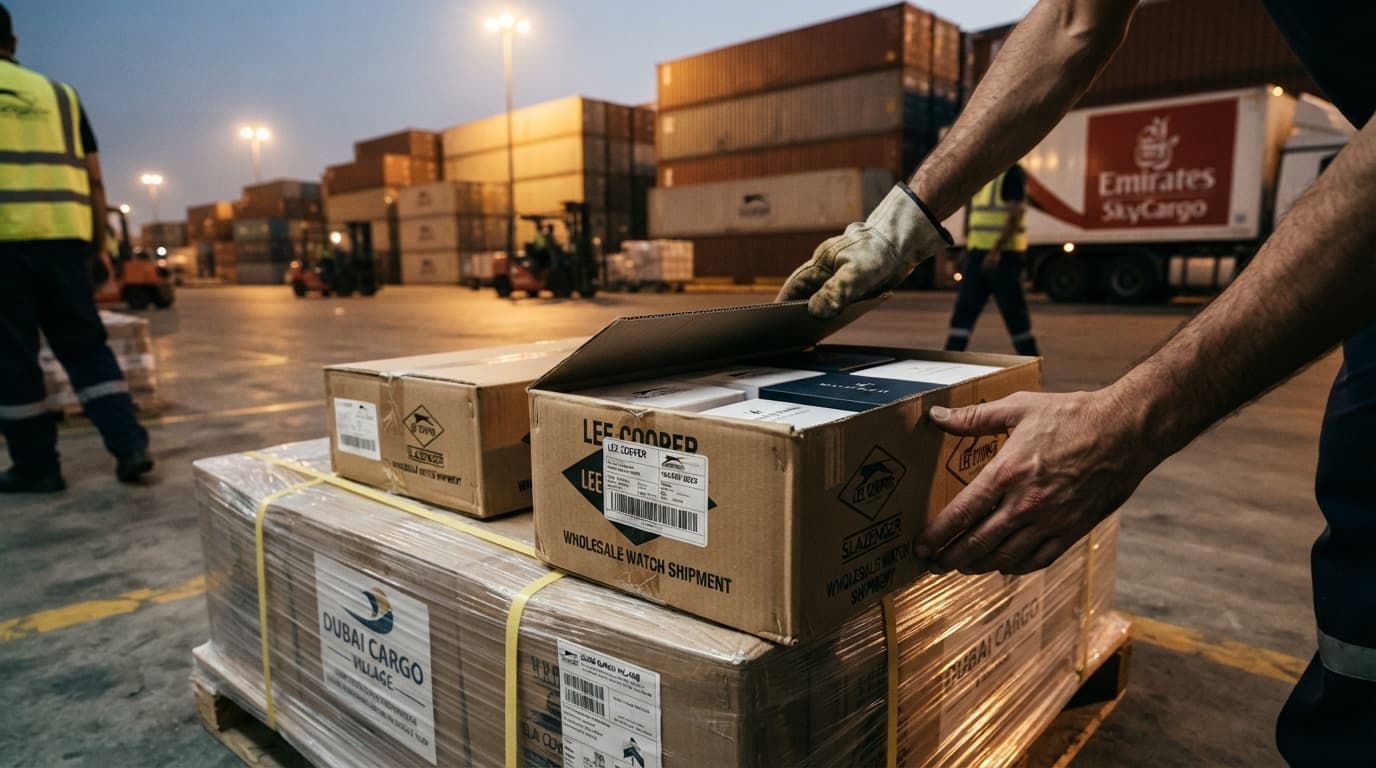
According to the current wholesale pricing and payment FAQ, wholesale orders are quoted EXW from the UAE or New Zealand facility unless otherwise agreed.
Shipping is quoted separately, while import duties and taxes in the destination country remain the responsibility of the buyer as importer of record.
Retailers should therefore confirm the actual dispatch location, shipping quotation and agreed responsibilities before making payment. An EXW quotation should not be treated as a delivered or duty-paid price.
6. Understand the Import Requirements of Your Destination Market
Import procedures are not identical across countries. The required documentation, customs classification, duty rates and tax obligations depend on the destination and the characteristics of the imported watches.
The following are general starting points for several relevant markets. They are not a substitute for checking current national regulations.
New Zealand
Commercial watch imports must be cleared through New Zealand Customs. Importers should prepare the required electronic import or cargo entry, pay applicable duties and GST, and provide supporting documentation.
Retailers should also check whether commercial importer registration and additional customs procedures apply.
Reference: New Zealand Customs – Start Importing.
Australia
Australian importers need to determine the correct tariff classification and customs value of their goods.
Import declarations and applicable duties, GST and processing charges may be required. For eligible taxable imports, Australian GST is generally calculated at 10% of the value of the taxable importation, which can include customs value, duty, and relevant international transport and insurance costs.
First-time importers may benefit from engaging a licensed customs broker.
References:
United Kingdom
Businesses importing watches into Great Britain generally need a GB Economic Operators Registration and Identification (EORI) number and must complete the relevant customs declaration procedures.
Import duty and VAT depend on the tariff classification, customs value, origin and applicable rules.
Reference: UK Government – Import Goods into the UK.
European Union
Commercial imports into EU member states are subject to applicable customs procedures and import VAT requirements.
Retailers should check the Common Customs Tariff and the VAT rules of the destination member state. The correct customs classification is particularly important because different types of watches may fall under different tariff subheadings.
Reference: European Commission – Import VAT Rules.
Philippines
Businesses importing watches into the Philippines should verify the applicable tariff classification and duty rate through the Philippine tariff system.
Imported goods may be subject to customs duties, VAT and other applicable charges. The importer or an authorised customs broker must also complete the relevant goods declaration procedures.
References:
- Philippine Bureau of Customs – Guidelines on Importation
- Philippine Bureau of Customs – Process of Importation
- Philippine Tariff Commission – Tariff Classification.
Check the correct HS code
Watches should not automatically be assigned one universal customs rate.
The Harmonized System (HS) classifies products for international trade. Watch classification can depend on characteristics such as the type of movement, materials and construction.
The World Customs Organization maintains the international Harmonized System framework, but importers should confirm the applicable national tariff classification with their own customs authority.
Reference: World Customs Organization – Harmonized System FAQs.
7. Prepare the Required Export and Import Documents
Documentation is an important part of international watch sourcing. Missing or inconsistent paperwork can delay customs clearance and create additional costs.
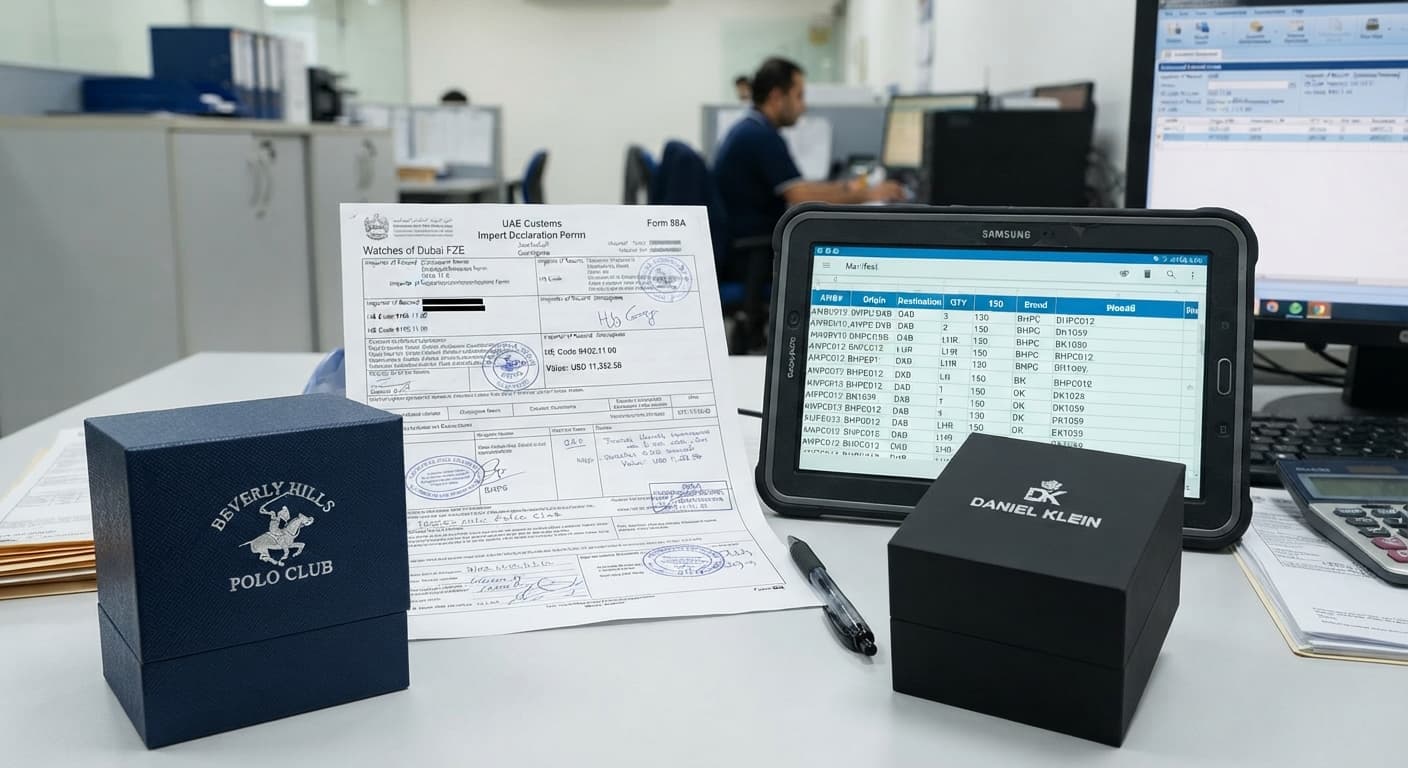
For a typical commercial shipment, retailers should discuss the following documents with their supplier and freight forwarder:
Document | Purpose |
|---|---|
Commercial invoice | Identifies the buyer, seller, goods, quantities and declared values |
Packing list | Describes the shipment contents, packaging and quantities |
Air waybill or bill of lading | Provides transportation and shipment details |
Certificate of origin | Establishes origin where required or relevant |
Export declaration | Records the export movement through the applicable customs system |
Import declaration | Provides the information required by the destination customs authority |
Warranty documentation | Establishes the agreed product warranty arrangements |
Dubai Customs provides procedures for submitting import and export declarations. Its guidance identifies documents such as invoices, packing lists, certificates of origin and applicable permits as part of customs documentation requirements.
See Dubai Customs – Submit Customs Declaration.
Not every shipment will require every document listed above. Requirements should be confirmed with the relevant customs authority and shipping provider.
8. How to Import Watches from Dubai: A Step-by-Step Process
Once the supplier, products and purchasing requirements have been established, the import process becomes easier to manage.
A practical sequence for retailers is:
Step 1: Identify the watches you want to purchase.
Prepare a list of brands, model references, quantities and preferred price ranges.
Step 2: Request a wholesale quotation.
Ask the supplier to provide model-level pricing, availability, product condition, warranty details and applicable purchasing terms.
Step 3: Verify the supplier and products.
Check the legal business details, sourcing channel, product documentation and agreed after-sales arrangements.
Step 4: Confirm the shipping terms.
Establish whether the order is EXW, FOB, CIF or another agreed Incoterm. Identify the named location and clarify who handles export and import clearance.
Step 5: Calculate the landed cost.
Obtain freight and insurance quotations, confirm the applicable tariff classification and estimate destination duties, taxes and brokerage charges.
Step 6: Prepare the import documentation.
Coordinate with the supplier, freight forwarder and customs broker to ensure that the invoice, packing list and transport documentation are consistent.
Step 7: Arrange payment and dispatch.
Follow the agreed payment terms and confirm the shipment details, insurance arrangements and dispatch date.
Step 8: Complete customs clearance and receive the shipment.
Submit the required import declaration, settle applicable charges and arrange delivery to your business premises.
Step 9: Inspect the watches.
Check the quantities, model references, packaging and physical condition against the purchase order. Record any shortages or damage immediately.
9. Start with a Pilot Order Before Scaling
A new supplier relationship should be tested before a retailer commits substantial working capital.
A smaller initial order can help establish whether the supplier meets expectations regarding product quality, documentation, dispatch times and communication.
After receiving the shipment, record:
- Actual landed cost per watch
- Delivery time compared with the quotation
- Product condition and documentation
- Missing items or discrepancies
- Faults and after-sales response
- Initial sales and stock turnover
This information helps determine whether the supplier is suitable for repeat purchasing.
It is also worth comparing wholesale purchasing with dropshipping before committing to larger stock quantities. Wholesale can offer more control over inventory, while dropshipping can reduce the amount of capital tied up in unsold watches.
For a detailed comparison, see Wholesale vs Dropshipping Watches: Which Model Gives Better Margins?.
Request a Wholesale Watch Quotation
Tell our wholesale team which brands, models and quantities you need. We can review availability and discuss supply options for your destination market.
Explore Wholesale Supply
Frequently Asked Questions
Is Dubai a good place to source wholesale watches?
Dubai can be a useful sourcing location because of its international trading connections and access to different watch supply channels. However, retailers should assess the supplier, product authenticity, documentation, shipping arrangements and landed cost before purchasing.
Are watches purchased from Dubai genuine?
They can be. However, retailers should verify the supplier and the sourcing channel rather than assume that every watch sold in Dubai is genuine or officially authorised. Request product references, supporting documentation and written confirmation of the warranty arrangement.
What is the minimum order quantity for wholesale watches from Dubai?
There is no universal MOQ. It depends on the supplier, brand, model availability and commercial agreement. Some suppliers accept flexible quantities, while others require minimum purchases per reference or order.
Do I have to pay customs duties when importing watches?
In most cases, commercial imports are subject to applicable customs duties and taxes unless an exemption or concession applies. The actual charges depend on the destination country, customs classification, origin and customs valuation.
What is the difference between EXW and DDP?
Under EXW, the buyer generally arranges collection, transport and customs formalities from the named seller location. Under DDP, the seller assumes responsibility for delivery, import clearance and applicable import duties and taxes at the agreed destination.
Can I arrange my own shipping from Dubai?
Yes, subject to the supplier's agreed delivery terms and export requirements. Under EXW, the buyer generally takes responsibility for arranging collection and transportation. The parties should clarify export clearance responsibilities before shipment.
What documents should I request when importing wholesale watches?
Common documents include a commercial invoice, packing list, transport document, applicable export declaration and any required origin or product documentation. The destination customs authority determines the actual import requirements.
Request a SKU-Level Wholesale Quotation
Retailers considering wholesale watch sourcing can contact Watches of Dubai to discuss their required brands, model references and order quantities.
Provide your business details, destination market and preferred products so the wholesale team can check availability and prepare a relevant quotation.
Before confirming your purchase, review the wholesale pricing and payment information and agree on the applicable shipping and import responsibilities.
Free Download: WOD Import Readiness Checklist
Planning to purchase wholesale watches from Dubai?
Before confirming your next order, make sure you have checked the supplier, product references, quotation, shipping arrangements and import requirements.
The WOD Import Readiness Checklist is a practical resource designed to help watch retailers prepare for international purchases and avoid overlooking important costs or documentation.
What's included:
- Supplier and product verification
- Wholesale quotation review
- Incoterms and shipping responsibilities
- Import documentation requirements
- Landed-cost calculation
- Final order approval checklist
Download your free copy and use it as a reference before approving your next wholesale watch purchase.
Download the Free WOD Import Readiness Checklist – PDF
Methodology and Editorial Limitations
This guide is an original procurement resource based on published Watches of Dubai wholesale and FAQ information, alongside publicly available customs and international trade guidance.
Incoterms explanations refer to the ICC Incoterms® 2020 framework. Import requirements are general guidance and may change. Actual duties, taxes, customs classifications and documentation requirements must be verified with the destination country's customs authority or a qualified customs broker.
The landed-cost calculation is illustrative and does not represent an actual Watches of Dubai quotation or a universal customs duty rate.


